


Why are my pine trees turning brown?
 Print
Print Email
EmailKnowing which species of pine you have and the time of year you first see symptoms can help you identify the problem.

As spring arrives, we begin to see browning of pine needles in plantations, landscapes and along roadsides. Depending on the type of pine tree, there are several common causes of needle browning in pines.
A crash course in pine ID
The most common pines in residential and commercial landscapes in Michigan are eastern white pine, Austrian pine and Scots (or Scotch) pine. Unlike many other conifers, needles on pine trees are clustered together in groups called fascicles. Determining the number of needles in a fascicle is the first step in identifying pines. White pines have five needles in each fascicle. The needles are thin and soft and often pale green. White pines have long (4” or longer), slender cones. Austrian pine and Scots pines are part of group known as hard pines along with our native jack pine and red pine. Hard pines have two or three needles in each fascicle. Scots pines have shorter (1 1/2'” or less) needles and smaller cones than Austrian pines. Older Scots pines have orange-reddish bark, whereas the bark on Austrian pines is grey.

Environmental – related issues

Conifers located along the road can be damaged by road salt. Road crews apply sodium chloride and other deicing materials to keep roads clear in the winter. Many plants, especially eastern white pine, are sensitive to salt spray from roadways. Acute damage caused by direct salt exposure is easy to spot since the damage is usually greatest on the side of the trees facing the road. Sensitive trees such as white pine can usually survive one-year’s damage but repeated acute damage can ultimately disfigure or kill trees.
Another culprit is winter injury. Many conifers are subject to needle drying of winter burn during the winter. The most common symptom of winter burn is brown or red foliage on the exposed (often south) side of the tree. In some cases, trees will have a snowline below which no damage occurs since those needles were under snow when the rest of the tree was drying. Winter burn occurs frequently on dwarf Alberta spruce but can occur on other conifers as well.
In addition, several possible fungal pathogens can cause these symptoms as well.
Dothistroma needle blight
Austrian pine is commonly affected by Dothistroma needle blight. The foliage of the lower half of the tree turns brown in March to April.
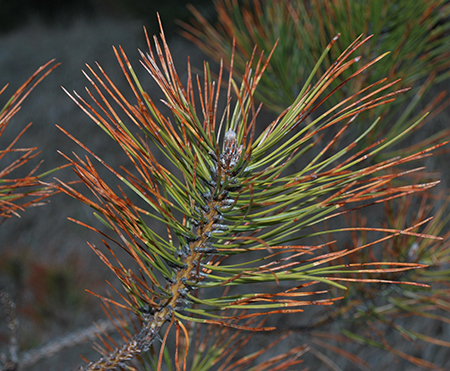
Dothistroma needle blight is caused by the fungus Mycosphaerella pini. This common pine pathogen kills needles of all ages and can weaken or kill Austrian pine trees. Characteristic symptoms of Dothistroma infection is the presence of needles showing browning at the tip of the needle while the base of the needle remains green.
The black fruiting bodies of the fungus can be seen in the dead spots or bands on the needles. Dothistroma spores spread by wind and rain and can infect needles throughout the growing season. New needles are susceptible once they emerge from the needle sheaths. The black fruit bodies appear in the fall; however, the spores are released the following spring and summer. The best protection of new needles can occur when applying copper-based fungicides as the new needles emerge from the needle sheaths and as the spores are released from the fruiting bodies. This is usually June and July. Reports suggest that pruning infected branches helps reduce disease.
Brown spot needle blight
Brown spot needle blight (Mycosphaerella dearnessii, syn. Scirrhia acicola) is relatively new to Scots pine in Michigan. Needle spots can appear on needles at any time of the year, but most commonly occur during August and September when trees suddenly turn brown just before growers are ready to harvest. Short-needled Scots pine varieties such as Spanish and French-green are more susceptible to fungal attack than the long-needled varieties.
Brown spot can be controlled by fungicidal sprays. The first application should be applied when the new needles are about half-grown (May-June), and a second spray three to four weeks later. The spray interval may need to be shortened in rainy conditions.

Lophodermium needlecast
Lophodermium is a severe needlecast of Scots pine, which in some cases can cause the entire tree to brown in spring. Even though we see the symptoms of Lophodermium in spring, the most important time to protect trees is from the end of July through September. This is when needles are infected from spores being released by the small, shiny, football-shaped, black fruiting bodies that form on the fallen needles. To break this disease cycle, the time to manage this disease with a fungicide is particularly in late July and throughout August, but maybe even into fall if it the weather stays warm and moist.
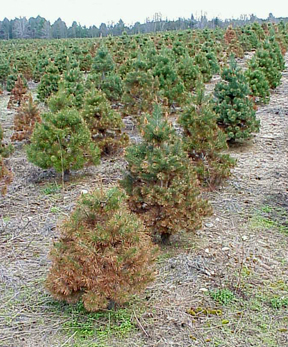
You can help identify the disease your trees have by knowing the species of pine and the time of year you first see the symptoms. To confirm which needlecast disease you have, send a sample to MSU Diagnostic Services. The cost for a sample is $20.
Pine Tree Disease Overview
Disease: Dothistroma needle blight
Symptoms appear: March/April
Species: Primarily Austrian but also on Red pine, Scots pine
Timing of control: May - July
Disease: Lophodermium needlecast
Symptoms appear: April/May
Species: Primarily Scots pine but also found on Austrian and Red pine
Timing of control: August - September
Disease: Brown spot needle blight
Symptoms appear: August/September
Species: Primarily Scots pine but also on Red pine, Austrian
Timing of control: May - June